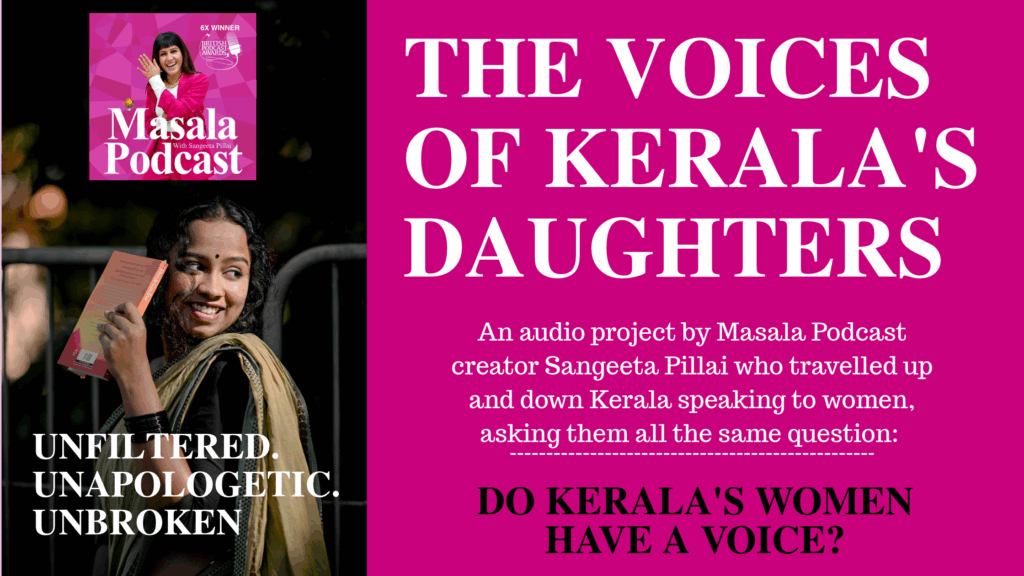
Special Episode Masala Podcast: the UK’s biggest South Asian feminist podcast
CLICK BELOW TO LISTEN🡇
Do Kerala’s women have a voice? Find out…
Welcome to the culmination of a three-year project in Kerala.
Masala Podcast creator Sangeeta Pillai was born in Kerala & grew up believing that Kerala’s women didn’t have a voice. She grew up in a strict Malayali household where her mother had no voice, her father was an abusive alcoholic who battered her mother. So she believed that Kerala had no value for its women, that their voices didn’t matter.
Sangeeta rejected Kerala, believing that she couldn’t be a strong woman here.
Three years ago, Sangeeta decided to challenge her belief. She travelled up and down Kerala speaking to all kinds of women: from girls in schools, professors in colleges, women running small businesses to women working in the fields – and ultimately to Kerala’s Goddess Temples. The objective was to find out: do Kerala’s women have a voice? The answers were surprising and life-changing for Sangeeta.
This special episode of Masala Podcast about Kerala’s Women’s Voices is being premiered at Local Sustainable Living, Kochi, Kerala.
Masala Podcast is the UK’s biggest South Asian feminist podcast – winner of 6 British Podcast Awards, 1 Audio Production Award & the Spotify SoundUp 2018 award. It has been featured in worldwide press like BBC Radio, Guardian, Metro, Cosmopolitan, Evening Standard, Stylist, Eastern Eye to Huffington Post as well as on giant billboards in New York, London, Dublin, Cardiff & Glasgow. Masala Podcast creator Sangeeta Pillai was born in Kerala, grew up in a Mumbai slum and is recognised as a leading voice for South Asian feminism globally.
Sangeeta Pillai is a feminist activist, podcaster and author. Her multi-award-winning Masala Podcast has won 6 British Podcast Awards, 1 Audio Production Award & the Spotify SoundUp 2018 award – and been on giant billboards in New York, London, Dublin, Cardiff & Glasgow.
Sangeeta grew up in a Mumbai slum fighting for her rights – and found her feminism early on. Today, she is recognised as a leading voice for South Asian feminism globally.
Sangeeta’s recent memoir Bad Daughter charts her journey from Mumbai’s slums to New York’s billboards, with inspiring themes around feminism, trauma, resilience & healing.
Available to buy at Idiom Books, Fort Kochi & Online at Amazon
“One of the most courageous pieces of writing I have ever read!” – Dipali Burns
“I’ve just finished your book! I’ve got tears running down my face!”– Karinne Faddy
“This incredible story ought to be made into a film!” – Jane Tuck
An inspiring feminist journey from Mumbai’s slums to New York’s billboards
I grew up in Mumbai’s slums with a violent, alcoholic father. I was called a “Bad Daughter” for not following the rules for “good Indian girls.” I had a fire in my belly that nothing could dampen, not even my mother’s brutal death & deep Indian patriarchy. I built a new life in London, creating a successful podcast & platform to inspire other women.
Bad Daughter: A story of feminism, trauma, resilience & healing
Despite all my successes, I couldn’t outrun the past. Faced with debilitating mental health, I went on a healing journey exploring everything from psychotherapy, hypnotherapy, EMDR, acupuncture to Tantra. But to truly heal, I had to go back to my birthplace in tropical Kerala. where I experienced the most profound spiritual healing in Kerala’s fierce goddess temples. Because ultimately, healing is about facing the deepest, darkest parts of yourself.
For those seeking feminist inspiration…
Bad Daughter is perfect for women who loved Untamed, We Should All Be Feminists & Educated. This powerful true story is a reminder that being your authentic self can transform your own life – and the lives of others too.
THE VOICES OF KERALA’S DAUGHTERS: UNFILTERED. UNAPOLOGETIC. UNBROKEN.
Kerala hurt me, so I rejected Kerala.
I was born in a tiny village in deep rural Kerala, where the mango trees swayed and the coconut trees danced.
I wasn’t born hating Kerala, but this land gave me a father who battered my mother every single night.
Kerala gave me a culture which insisted that women stayed with their husbands, even if those husbands almost killed them.
Kerala gave me a belief that girls were a burden, to be married off at the first available opportunity to the first available man.
Kerala gave me an understanding that women had zero value, that their voices didn’t matter.
So I rejected this land.
I rejected the lush palm trees, the winding backwaters.
I reject the language and the culture of Kerala.
I rejected it all because I believed that this soil had no space for a woman’s voice.
Voice.
I distanced myself completely from Kerala until three years ago, when I went back to finish writing my memoir, Bad Daughter, for the first time.
I voluntarily spent many, many weeks here on my own.
I traveled up and down this fierce, beautiful land, and I spoke to a lot of different women here.
I asked them all the same question, Did Kerala’s women really have a voice?
I spoke to young girls in a school, their eyes bright, their giggles infectious.
I stood before older girls in a culinary school where they were learning to be powerful with Kerala’s ancient martial art.
I sat in a little restaurant run by a woman who set up her little business, made her own money.
I listened to a professor in a girls college, dismantling the patriarchy and challenging traditions.
I stood in the fields with a woman who toiled under the blazing Kerala sun, her voice as strong and enduring as the soil she tended.
Finally, I discovered the divine feminine in Kerala.
So what did I learn?
Well, I learned that I was wrong.
Totally wrong.
If you want to know how wrong I was, carry on listening.
I’ll share what I found at the end of this podcast.
I’m standing outside St. Teresa’s, a convent school in Kochi, a city made up of tiny islands sitting by the sea.
In Kerala.
The students of this school wear these blue pinafore uniforms and white shirts.
It reminds me so much of my own convent school in Mumbai, my own grey and white uniform, which always had to be below the knees.
This school, just like my school, is run by a church with its nuns and priests.
As I stand there, the animated buzz of young girls, excited voices and giggles rise up in the air.
I approach a few of the students standing outside, chatting with each other.
Do you think Kerala’s girls have a voice?
Yes.
Why do you think that I don’t know.
What do you want to be when you grow up?
I want to be a doctor.
I want to be an air hostess.
Cardiologist.
I want to be a fashion designer.
Doctor.
Doctor.
Police.
Police.
Lawyer.
Thank you so much.
I’ve been in Kerala a while now and I haven’t really managed to get any in depth interviews with young girls.
I really wanted to speak to the young women of Kerala because I want to understand if their experiences of growing up are any different from mine.
I want to hear if young girls and women in Kerala have a voice.
So finally I managed to get introduced to some young girls here, some students who’ve agreed to be interviewed by me.
Here’s what they had to say.
Tell me your name and how old you are.
I am Nainika pa and I am 13 this year.
I am Diona Maria Anthony and I am 15 this year.
Alina Joseph and I am 16 this year.
I’m Ashna Rosandini and I’m 18 years old.
Do you feel like you have a voice in Kerala today?
Yes, I do feel like we have a voice in Kerala sometimes.
It’s complicated, but usually we do get a voice, but not always.
When do you think you don’t get a voice?
Not always.
What we say or do is right for our parents or for our older people than us.
So I feel not always we have a voice.
It’s a yes, but a no, because all the people will always judge the younger ones.
And sometimes we don’t have our voice to speak up because their opinion is more valuable than usual when it comes to a family and parents, it’s hard because they will be the ones who are with us always.
And they took care of us this whole year, so we have to listen to them, what they say.
So I think it’s kind of hard sometimes, but we still can have our own life.
It depends sometimes on what we will do, what we’ll say like that.
Can you give me an example, either of you, where you feel like you want to say something but you can’t?
I had a dream to become an air hostess, but my parents didn’t really like it.
So my mom wanted me to be a nurse.
So I kept that dream aside so that she can feel proud of me being a nurse.
I feel like my friends and all their parents let them out, like whenever they want to go.
And when they invite me to go somewhere, I ask my parents and I need their permission because I’m under 18.
Not all the times, but at times when I ask her, she’s like you don’t have to go because you have other things to do and it’s not important.
So sometimes I feel like my wishes or my decisions don’t really have an importance when it comes to our community.
Because our older ones, our parents, are the ones who makes the decision in our life.
So I feel like it’s a yes or no situation.
I absolutely get it.
Something else I was thinking about.
I remember when I was a kid or when I was a young woman, not a kid, like 15, 18, there was a lot of emphasis on what other people will say.
Their voices were more important than my voice.
Do you find that society will judge women in many situations?
Our parents will only listen to the society, not us.
Yeah, I used to always think it’s like what they’re saying is more valuable than what your own child is saying, you know?
And it always felt like this society had this very big voice.
They had a voice about everything.
They had an opinion about what I wore, whatever I went to school, what time I came back, was I speaking to a boy?
You know, there were just so many things that they had voices up on.
And my mother would always listen to that.
And what my voice didn’t really matter.
My parents used to compare me with others that make me so sad.
Sometimes even it comes to dressing, wearing lipstick.
Our parents always say that, don’t wear too much lipstick.
People will say something wrong about you and they will judge you.
We don’t have our own freedom in Kerala.
I see.
Like that.
They always used to compare with others.
Our voice or our opinions are not valuable there.
Absolutely true.
Do you find that too?
Sometimes if I find something unfair, I tell my parents that she has that, so why can’t I have that?
And they said that, don’t compare yourself to others.
But when I do something bad, they’re like, why did you do this?
That girl over there didn’t do that.
Mostly in our lives, ever since we are born, the only thing that we’re taught is that you should always listen to what the society says.
Not from our heart.
Not our heart, our brain.
Most of the time, the women in Kerala, the society is shaming and controlling them and stuff like that.
We really try to meet their expectations, but most of the time we just fail to do it because we’re just being ourselves.
It’s almost being yourself is not acceptable.
And you have to kind of mold yourself into this version of girlhood, womanhood that the society has decided you should be right.
When you think of society and voices, who do you think of for Me, it’s like this annoying auntie that’s sitting and watching everything you do.
Because I had an annoying auntie.
The building that I lived in, she used to literally sit on the kitchen platform.
And she would watch what time who came.
She would actually watch it.
And then she would tell my mother, your daughter came back at midnight yesterday.
What was she doing?
They are like CCTV cameras.
They always watch us, what we are doing, what we are wearing, where are you going?
Which time you are coming.
They always watch us more than our parents.
And they try to find our mistakes more than the good things we do for a minute.
Like, just imagine there’s a world in which you can have a voice, any voice you want.
You can do what you want, you can wear what you want.
What does that world feel like?
How does it feel?
I visited Qatar on the first day we went there.
The kids there were asked to go to the grocery store.
So we were going with them.
And we weren’t all perfect.
Doing our hair, wearing lipstick.
It’s just nearby.
But we are like that here because everyone judges us if we go in a messy hair.
But they just woke up from their sleep, their hair is so messy.
They just get out of the door and they go.
And we’re like, don’t you at least want to comb your hair?
And they’re like, who’s gonna care?
And they go out, nobody cares.
They are living their life.
They’re doing what they do.
And when I was there for half a month, I was so free.
I can say do or do whatever I want.
But when we came back, we can’t do like that.
Because even going to the nearest store, we have to be looking good.
Or the boys or any uncles, they’re all like, look at what she’s wearing.
It looks like rubbish.
She just came out of her house and like that.
Say you’re 30.
What would your ideal dream life be like?
I don’t want to stay here.
I want to settle somewhere outside of this country.
Because I feel this country is pretty judgy of whatever we do.
Because in boys, they don’t care if their Bennion’s shadows is showing or if their shirt is a little up.
But when we are the ones who’s wearing something like that, and if even a little bit of strap is shown, bra strap, it is really judgmental.
We all have a same mindset, so that would be help our children to be free and peaceful.
They’ll have a happy life so we know what it feels like.
So we’ll make our Generation so beautiful.
What about you, young lady?
I would just get out of this country and start my own life.
I don’t want anybody judging me nor anybody that I care about.
The society is trying to make women better, but instead they’re just making them feel bad by shaming them.
So in other countries, this is not the same.
So I just want to travel to some better place.
And my dream is to become a graphic designer.
The society does not approve of graphic designing, drawing, stuff like that.
But they say that minimum wage, you won’t find anybody to marry if you do that.
I don’t care about marriage.
I just want to live my life.
In my grandmother and mother society, they were also judged.
So that’s how they became like they are now.
And that’s how this society is formed.
I think one of the things I find really sad, but it’s the reality is how it’s the women judging other women.
It’s the older women, it’s the aunties, it’s the mummies.
They are the ones judging us.
And what you touched upon is exactly that, because they experienced that.
And then they’re doing it to other people because it was done to them.
So what about you?
Do you think compared to your mother or your grandmother, you have more of a voice in Kerala today?
Maybe because just like she said, our parents must have gone through even more judgment issues when they were little, and their mother also have forced them.
So when they’re growing up, they feel like people are judges.
So you should make your children grow in a proper way that people won’t judge like.
But that only makes the other generation gets on this cycle that keeps on going and going.
As I stay in Kerala, I’m hearing about these schools here that teach kalaripayattu, which is an ancient martial art indigenous to Kerala.
This martial art is thousands of years old and has been practiced across many generations here, taught by many great masters in villages and towns all over this green land.
It was usually taught to men and boys as a way to overpower enemies and defend themselves, protecting their villages and kingdoms.
But now something wonderful is happening in Kerala.
Kerala.
Girls and women are being taught kalari in several schools all over Kerala.
This is exciting to hear because traditionally, women weren’t even supposed to step out of the house, let alone learn a martial art like kalari, which would make them stronger.
I hear of a women’s kalari school called Dakshin Bharatiya Kalari near Fort Kochi, where I’m staying.
I arrive and I can immediately hear the sticks clicking against each Other as the girls learn to wield them in an intricate sort of dance of self defense.
I love this so much because I know that violence against women is rife in India, with India being called the rape capital of the world.
So training young girls and women to defend themselves, make them physically stronger, using Kerala’s own ancient martial art.
This is just amazing.
Here’s some of the women that I spoke to.
So what’s your name?
My name is Vaiga.
How old are you?
I’m 11 years old.
And how many years have you been practicing kalari?
Like, one year.
And how does doing kalari make you feel in your body?
After I started kalari, I was, like, more energetic.
Yeah.
And I started running marathons.
I feel physically stronger, better than before.
If somebody attacked you on a dark street, what would you do?
I will defend them.
Can you explain what you would do physically?
I would kick him straight in his face.
Do you think the girls of Kerala have a voice?
Yeah, they do, because they have to stand for themselves.
They don’t have to be afraid of the dark, afraid of the creepers, afraid of the men.
They need to go in the dark sometimes.
Yeah.
I love that.
Thank you so much.
After speaking to really young women, I wanted to speak to some slightly older women, women going to college.
I remember being quite lost during my own college years.
I was battling with very strict rules at home and then seeing all these liberated young women at my college in Mumbai, my brain and my body sort of shut down as I tried to find out who I was.
But here in Akulam in Kerala, I find a wonderful women’s college called St. Teresa’s I end up speaking with young women studying here and even giving them a talk on how to become podcasters.
Finally, I speak to this amazing feminist professor, Priya Nair, who I’m told has managed to convert most of this college into feminists.
Here she is now.
I don’t know if the Malayali woman has a voice, because Kerala is a very paradoxical society.
On one hand, we have education, we have employment.
But whether this translates to empowerment, it is not very certain because we do not know how much agency they have, how much spending power they have, how much freedom they have, because the society that is very patriarchally biased, patriarchy is entrenched in the culture, I would say.
So it is very difficult to make out whether women have a voice.
You have communism on one hand, which is supposed to be an emancipating ideology.
But even within communism, you do not find many women who are articulate or who can take a stand.
I don’t know if a woman can actually hold her own against the party.
Even if she’s a commerce, she has to obey the party lines.
And her spending power, that is another area which is of great concern.
There are n number of women’s magazines in Kerala, and most of them only advertise products like makeup or jewelry or sarees.
So we understand that the earning woman also doesn’t have much of spending power.
I’m not sure about the rest of India, but in Kerala I think women are now supposed to multitask, right?
You can go out and work, but then you come back home and you do all the work that is expected to be done by a woman.
So her burden has actually increased.
There are women who speak about feminism and all that, but sometimes I think it is very superficial because there’s academic feminism.
They speak from a very privileged position and they do not take into account the lives of ordinary people.
And some of them are just, you know, nine to five feminists or social media feminists.
So it is very difficult to find out the voice of the Malayali woman.
Like I said, it is a very hypocritical and society ridden with paradoxes.
And sometimes you have to navigate your way through all these mines that are buried underneath.
As I get on the road in Kerala, traveling across the state in trains, taxis, and many, many tuk tuks.
These tuk tuks, they twist and turn with me, holding on tightly to the bar in front so I don’t feel fall out.
As I travel, I notice something that surprises me.
A lot of the little shops in the little villages and towns that I travel through are run by women.
Women run the fruit shops where I buy luscious mangoes and pineapples.
Women run the pharmacies where I stop to buy cough drops and creams.
Women run little tea shops, groceries, clothes stores and restaurants.
This is very, very different to the rest of India.
Even the big cities don’t have many women running businesses.
And then I meet a woman called Sheba who runs a tiny little cafe which serves sort of fresh Kerala food that I love.
The lunches here are delicious red Kerala rice, spicy fish curry, crunchy hot fried fish, and that delicious mix of vegetables called avial, all for less than a few dollars.
I go see Sheba very often.
She’s in her late 50s and has run this little restaurant over 20 years.
She has two other women who help her cook and serve.
All sorts of people come to her restaurant, lured by the delicious smells wafting out of the door from Tuk Tuk.
Drivers grabbing a quick meal.
School teachers who stopped by for a refreshing tea after a hot day.
Teaching young shop assistants who pop by during their lunch hour.
And Western tourists brave enough to venture into a local restaurant.
Here’s a bit of Sheba’s story.
She’s more comfortable speaking Malayalam, the local language of Kerala.
So I’ve translated some of her words here.
Do you think you have a voice in Kerala?
Yes.
And when you started this restaurant, were there people who said, no, you can’t do it?
I started two years back.
So many people said, don’t start this.
Don’t do this.
Especially my husband.
But still, I do it very successfully.
It is very successful.
Every time I come here, it’s packed.
Sheba makes like the best food.
And it’s really, really reasonable.
So all sorts of people come here.
Sheba, how did you make these restaurants to success?
My courage.
My confidence.
Struggling.
Lifetime.
My confidence comes from a lifetime of struggling.
The struggle gave me confidence.
I believe that I can stand alone.
I can stand alone with strength and pride.
I don’t go to anyone else to ask for help.
So I’ve learned quite a few things in my life.
I’ve got two kids.
I’ve had a lot of big problems in my life.
So many problems during those tough times.
It’s my confidence and my courage that has brought me this far.
I believe that I’m capable and that I can do anything I want.
I have that ability.
I don’t need to go looking outside for help.
I’m able to do anything that I want.
And that’s how I started this restaurant.
When I started this place, I started small.
For 10 years, I was only making snacks, tea and coffee.
After a while, I realized that I needed to make more money.
After that, I kept making the restaurant better.
It’s a proper restaurant.
I turned it into a place where you can eat different types of food.
When I look back at what I’ve achieved, I’m really happy.
And what do people say about your restaurant now, Sheba?
Go anywhere in the world, whether you’re a Malayali or a foreigner.
All you need to do is search on Google.
You’ll find the name of my restaurant, the address, and you’ll find how people know me.
There are lots of people in the world, but I’m well known on Google.
And I think that’s a big achievement.
When I think of my life from the time I was born, I feel like I’m someone who has achieved great things in life.
I didn’t waste my life.
I struggled a lot, but I also achieved a lot.
And that is my biggest strength.
For my kids, for my girls, I am an inspiration.
If they think about what their mother has done, they can see that the world knows that their mother.
Lots of people know me.
The world knows me.
That’s amazing.
That’s absolutely amazing.
And now, Sheba, is there anything you want to say to young girls in Kerala?
Why should they have their.
Why should they have a voice?
Why is it important all over the world?
It’s the women that struggle.
Women are the ones who endure pain every month on their periods.
Women undergo so much pain in so many ways.
They work so hard to raise their children, to keep their families strong.
They go through so, so much, whether they are educated or whether they are not.
It’s the women who struggle.
It’s the women who can rise above the pain and the struggle.
It’s the women who can lift their families out of poverty, even if they have no education.
If a woman has a strong spirit, she can do anything.
I can say this because that’s what I’ve done in my own life.
If a woman makes up her mind, if she has the courage, she doesn’t need to go begging anyone for help.
She can make something of her life.
She can do anything in her life.
Women don’t need to fear anyone or anything.
We can make our own money to live the life we want.
I travel an hour away from the city towards Alipi.
It’s 6.30am I’m standing in a field in deep rural Alipi.
Dawn is about to break.
I can see tendrils of light sneaking up into the sky.
The rich smell of freshly ploughed paddy fields is better than the finest perfumes.
I was born in a house near another field, just like this one in Kerala, a few hours from where I’m standing now.
As I think about all this and walk along the narrow edge of the field, I see someone and I stop.
An older woman wearing a printed cotton nightie.
He’s outside a little blue house.
She’s got a stick broom in her hand and she’s sweeping up the leaves in her front yard.
When she sees me, she stops and smiles at me.
Brilliant white teeth shine from a deeply tanned face.
Her eyes are soft and kind.
She invites me into her home, a total stranger who just happened to walk past her house.
She offers me tea and tells me about herself.
Her name is Leela ma and she’s 72 years old.
She’s a day labourer, someone who works six hours a day, doing all sorts of physical jobs from chopping trees, plucking grass, all to make a few hundred rupees, just a few dollars.
As she continues to talk, I realize that unlike me, Leela Ma doesn’t have the luxury of exploring her feminism.
I have the privilege of coming to Kerala to create this audio project about women’s voices, about finding my roots.
But women like Lila Ma are too busy trying to survive to earn a living, to make enough to feed herself.
I grew up poor in the slums of Bombay.
But now I live a very privileged life.
Compared to this lovely old lady, I spend more than what she earns.
After working all day on a cup of tea in London, this thought brings me down to earth very quickly.
I want to share my talk with Lilama with you.
She doesn’t speak any English, hence I’m translating her Malayalam words here.
Lilama, do you remember your childhood and how it was?
My mother died when I was three years old.
My sister was a year and a half old.
My father brought us up, looked after us, our neighbors to the left and the right of our house.
They all helped.
And with their help we managed to grow up.
We had nothing of our own really.
I guess when you have a mother, you have helped in your life.
We had nothing.
And that’s just how it was.
Lilama, tell me, in Kerala, as women who go to work and who grew up here, what is their life like?
The lives of women?
I know we wake up and we go to work in the fields.
And for six hours we work in the fields under the hot baking sun and in the rain.
We just work.
We really struggle.
And that’s how we live.
When I first came to live in this area, we earned 75 rupees less than a US dollar a day.
And I also had three kids, three girls to support.
I had to pay for their education, their food, their clothes, everything.
It was really, really hard.
My husband, he made 500 rupees less than $6.
And that’s what we had.
And that is how most women in Kerala live.
Even today.
Now most people, they can’t go to work in the fields.
I work as a daily laborer.
I earn 346 rupees.
That’s around $3 a day.
I work all day until 5pm Neelama, gosh, that’s a really, really tough life.
What choice do I have?
I have to live.
That’s it.
That’s my lot in life.
So Leelama, with this 350 rupees, what do you do?
346 rupees.
That’s what I get for a day’s work.
And I don’t get that immediately.
What do you use that money for, Leelama?
I pay the electricity bill, water bill, all the food and the medical bills if I get sick.
Look at all these medicines here.
So everything really.
I make it work.
So Leela Ma, your kids.
Tell me about them.
What are their lives like?
I have three girls.
Two girls, they live in rental accommodation.
The other one is okay.
She pays a share to her brother in law to live there.
But she has a good husband, so she’s doing well.
But my other two girls, they work hard, like me.
We work to collect and dispose plastic waste as part of a government program in Kerala.
Their husbands help, so they’re not starving.
But Lilama, it sounds really hard.
Yes, our lives are hard.
But what’s the choice?
We have to live, right?
We can’t just die.
Only when God calls.
We will go, right?
Yes, Leela Ma, that’s right.
So I’ve spoken with women up and down this land.
Now it’s time to speak with the ultimate female symbol of this land.
The Goddess.
There are so many Goddess temples in Kerala.
Big and small dot dotted all over this blessed earth.
It is shortly after dawn.
The birds begin their dawn chorus like a mini orchestra, one after the other after the other.
I am standing in front of a tiny temple just minutes from the old house where I was born.
In this tiny village in Kerala, I am where I began.
Not many people are up at this hour.
I enjoy the quiet and the connection.
I look at the glowing Nilavilakka, the bronze lamp, dark as the night sky with its many tears, shining, luminous with so many flames.
The lamp is glistening with the oil poured lovingly over the years by many priests and many devotees.
The deity I’m standing in front of is Goddess Bhavani, a form of Durga.
Bhavani literally means the giver of life.
She is the force of nature and the source of all creative energy in the cosmos.
The priests, they begin dressing the Goddess.
They bathe her first and they drape her sari.
Then they adorn her with jewelry.
As I watch them, I think to myself that doing this with such love and care, their heads bowed, their manner full of reverence.
It occurs to me that in a largely patriarchal land, even the men bow before the Goddess.
She is seen as the ultimate power and she is female.
As I stand before the Goddess, something strange and beautiful begins to happen.
My body starts to shiver and shake.
I glance around me to see if anyone else notices what is happening to me.
But no one does.
The shivering, as strange as it sounds, is not unpleasant.
The deity is in front of me.
Her face is hidden in deep shadows.
Then something even more magical happens.
My body feels as if it’s been lit up by a thousand lights, all shimmering inside me.
My hearing sharpens, magnified many times over.
I can suddenly hear everything around me.
I can hear every bird on every tree talking to one another.
The crows with their loud caws feel so close they could be in my ears.
I can even hear the other sounds they make.
The horse rattles and the sharp clicks.
I hear the gentle rustling of the leaves as the trees whisper to each other.
The early morning light shining on them.
I can sense the hundreds of thousands of creatures, big and small, that occupy this lush green space.
Each one living their lives searching for food and mates.
Propelled by their own divine purpose to exist on this earth.
The music starts to play in the temple.
Devotional songs in Malayalam My pulse quickens.
My heartbeat picks up.
My heart.
Gosh, my heart.
It feels like as if someone has split it wide open.
All the feelings come rushing in, gushing like a stream that’s been held back for far too long.
It’s as if my body is a finely tuned instrument.
And here, in front of the Goddess, it suddenly remembers how to play every note, every frequency, the sharp to the flat and all the harmonies in between.
That’s when the tears start.
And I let them flow.
I’m not sad.
I’m not angry.
I’m not upset.
These tears, they feel cleansing.
They feel healing.
As I stand here listening and feeling every single thing so deeply, I realize something.
Something.
The Sangeeta who came to this very temple thousands of times before has died.
She had to die so that a new version of me could be born.
I am now a spiritual, powerful, deeply connected being.
Standing here, feeling fully part of this earth, of this universe.
The temple bells start to ring.
Ding, ding, ding.
The sound goes straight to my heart, reverberating within me, touching every part of my body from my head, through my stomach and my chest, all the way down to the soles of my feet.
The tears disappear and I feel absolutely wonderful.
My heart is open, my body grounded, my spirit soaring.
I am filled with immense gratitude for what I’ve just experienced.
It feels as though after wandering in distant lands for many decades, throat parched and belly starving, I have finally come home.
I’m being nurtured and nourished.
The waves of love washing over me are indescribable.
This is what home feels like, and it’s more beautiful than any words can describe.
So here we are at the end of our journey together.
This journey has been a physical journey, but also an emotional and deeply spiritual journey for me.
I spent 50 years carrying a heavy, painful belief in my bones.
I believed that the women of Kerala did not have a voice.
I believed our tongues were tied and our opinions were shut down.
But after traveling up and down this stunning land, after sitting with the cafe owner, after watching the little Kalari warriors, after hearing the professor, after hearing the untamed spirit of the women in the fields, I stand and I sit before you.
Today, after having experienced the most profound spiritual feelings in the Goddess temple, I feel completely humbled.
I was wrong.
So wrong.
I started this episode by telling you that Kerala’s women didn’t have voice.
According to me, I learned that this is not the land of silent women as I had imagined.
This is the land of the Goddess and also of everyday goddesses who are reclaiming their space, their voices.
The patriarchy built walls to drown us out.
But you cannot bury the the descendants of the Goddess forever.
The women of Kerala are speaking.
They are laughing and fighting and demanding and thriving.
Watching them claim their space, hearing their strong voices in our mother tongue, has healed a fracture deep within my own soul.
So yes, I learned that I was totally wrong.
I also learned something else.
Not just in Kerala, but all over the world.
They’ve tried to silence us.
They’ve tried to drown out our voices.
But guess what?
They forgot that we are the earth itself.
We are the sounds of the storm, the fire of the volcanoes, the rattle of the wind, the rage of the river, the hunger of the seas.
You cannot silence us.
From the villages of our grandmothers to the city streets, we are speaking up.
We are a collective voice, rising and raging.
We are here, we are loud and we are are not going anywhere.
Thank you for listening to Masala Podcast.
I’d love to hear back from you.
Tell me what you think about this brand new season.
Anything you love, anything you don’t love, anything you’d like me to talk about more, just let me know.
Email me at email@soulsutras.co.uk or DM me on Instagram @soulsutras.
I’ll be back soon with more ancient Indian feminist wisdom.
Besharam Batameez Gandi.
Hai.
Hai.
Bad Beti
Manage Cookie Consent
To provide the best experiences, we use technologies like cookies to store and/or access device information. Consenting to these technologies will allow us to process data such as browsing behavior or unique IDs on this site. Not consenting or withdrawing consent, may adversely affect certain features and functions.
Functional
Always active
The technical storage or access is strictly necessary for the legitimate purpose of enabling the use of a specific service explicitly requested by the subscriber or user, or for the sole purpose of carrying out the transmission of a communication over an electronic communications network.
Preferences
The technical storage or access is necessary for the legitimate purpose of storing preferences that are not requested by the subscriber or user.
Statistics
The technical storage or access that is used exclusively for statistical purposes.The technical storage or access that is used exclusively for anonymous statistical purposes. Without a subpoena, voluntary compliance on the part of your Internet Service Provider, or additional records from a third party, information stored or retrieved for this purpose alone cannot usually be used to identify you.
Marketing
The technical storage or access is required to create user profiles to send advertising, or to track the user on a website or across several websites for similar marketing purposes.