
Women Finding Their Voices: No more staying silent
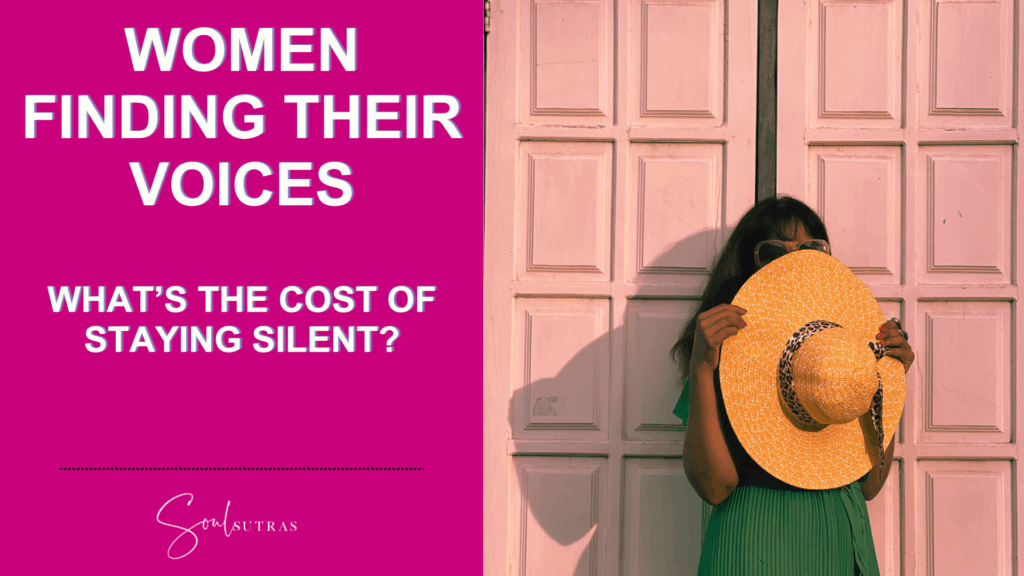
Women are taught early on to pack our words away. Keep them hidden. Lock them in the dark, damp cellar of our stomachs where nobody else has to deal with the stench of our rage. It spans cultures, borders, and generations.
Women’s empowerment isn’t staying quiet
If you’re reading this thinking that surely now in 2026, women do use their voices? But the glossy illusion of female empowerment we see played out on social media often masks a deeper truth. So many of us battle self-doubt, showing those smaller, quieter versions of ourselves because that’s what centuries of patriarchy taught us to do.
What’s the cost? When we stop women speaking up, we don’t erase their feelings. We just force them inward. The words don’t evaporate. They turn toxic.
Psychologist Dana Jack spent decades researching the effects of self-silencing. Her Silencing the Self scale laid bare a brutal truth. When we suppress our thoughts to keep the peace, when we bite our tongues so a partner or a colleague doesn’t feel threatened, it affects us deeply.
Our silence can cause clinical depression. Our silence can lead to suffocating burnouts. That’s not just me saying it – it’s a proven scientific fact.
We trade our mental health for the comfort of others. When we keep quiet, for years and years, a numbness sets in. (You know the one I mean, where you wake up one morning not really feeling anything. I know it, because I’ve been there, I’ve felt that.)
Breaking the silence is vital
Women get told that it’s all “in our heads”. I’m here to tell you that it’s NOT in our heads.
A landmark study presented to the American Psychosomatic Society tracked women who shut down (and played peacekeeper) during conflicts.
The data was chilling.
These women have 4 times the risk of dying from heart disease. As well as 4 times the risk of severe cardiovascular issues compared to those who spoke out.
The physical toll of swallowed words is literal. It affects our hearts, it affects our bodies.
It wouldn’t be an exaggeration to say that our silence is literally killing us. One paused argument, one polite smile at a time.
I was the compliant Good Girl for years…
For years, I played the part. The good Indian girl. Eyes downcast. Voice soft. Hands folded neatly in my lap while men took up all the air in the room.
My family expected quiet compliance. Society demanded it. I watched my aunties and my mother serve from dawn until dusk, their own desires packed away. I felt the heat of their unexpressed anger. I saw how it aged them, suffocated them.
One day, I stopped being silent. I started expressing my opinions. It wasn’t welcome. In fact, it was very hard. I stopped playing the good daughter and started to embody by Bad Daughter persona.
If a kitchen in a Mumbai slum feels too distant to you (that’s where I grew up!), I know that same heavy silence hangs in spaces everywhere. In boardrooms in London. In kitchens in New York. In living rooms in Lagos.
The stifled breath. The clenched jaw. The words held back. They all share the same silent language.
Speaking up is female empowerment
The truth is that finding your voice isn’t pretty. It isn’t an Instagram-ready moment.
It is a small, cracked voice shaking as it finally speaks the truth.
The first word spills out, raw and unpolished. The words taste wild. The feeling is euphoric.
You look around and realise the sky has not fallen. You’re still standing. You are louder, you are sharper. For the first time in your life, you are entirely your own woman.
10 little tips to find & use your voice
The truth about women speaking up is that it isn’t pretty, but it has to start somewhere. If you are ready to break the silence, here are 10 ways to start:
- Start small. Send back the cold coffee. Correct someone when they mispronounce your name. Feel the words forming in your mouth.
- Let your voice shake. It won’t sound smooth. The first crack of silence is always messy. Speak anyway.
- Drop the ‘sorry’. Stop apologising for taking up oxygen. Stop saying sorry before stating a basic fact.
- Locate your anger. It isn’t a monster; it is a compass. It tells you exactly what needs to be said.
- Practise the pause. When they interrupt you, stop. Hold their gaze. Say, “I haven’t finished speaking.”
- Write it out. If speaking feels too much, write it onto a page first. Then read it out loud to the mirror.
- Use ‘no’ as a complete sentence. No padding. No sweet excuses. Just a sharp, clean boundary.
- Kill the ‘Good Girl’. She is exhausting. She is built on your silence. Let her go.
- Find your loud women. Surround yourself with people who don’t talk over you. Find the women who make room for your voice.
- Breathe deeply. Take up physical space. Expand your lungs. Refuse to shrink.
One more thing…
If you are ready to stop swallowing your words, join me. Step into a room where we learn to take up space and turn our shaking voices into power. Look at my Women’s Podcasting Masterclass and start making noise.
The truth is: we cannot afford to keep the peace anymore. The price is our lives.
Speak out.
Got questions?
If you have questions about this course or want to find your voice in one-to-one sessions with me, feel free email me with your experiences/thoughts/feelings at email@soulsutras.co.uk